English| EUR
Suggested for you
More currencies
Choose a language
The Corinth Canal stands as one of the Mediterranean's boldest engineering interventions, a waterway that promised to rewrite centuries of maritime practice. Carved through solid limestone, it transformed the Isthmus of Corinth from an obstacle into a passage. This guide explains the canal's significance across engineering, trade, and regional identity.
Quick answer
The Corinth Canal is important because it eliminated the 400-kilometer detour around the Peloponnese peninsula, reducing travel time between the Aegean and Ionian seas by seven to ten hours. Its construction—completed in 1893 after 2,000 years of abandoned attempts—proved that late-industrial Europe could achieve what ancient Rome could not. Beyond logistics, the canal became a symbol of Greek sovereignty and technical ambition during a formative period of the modern state.
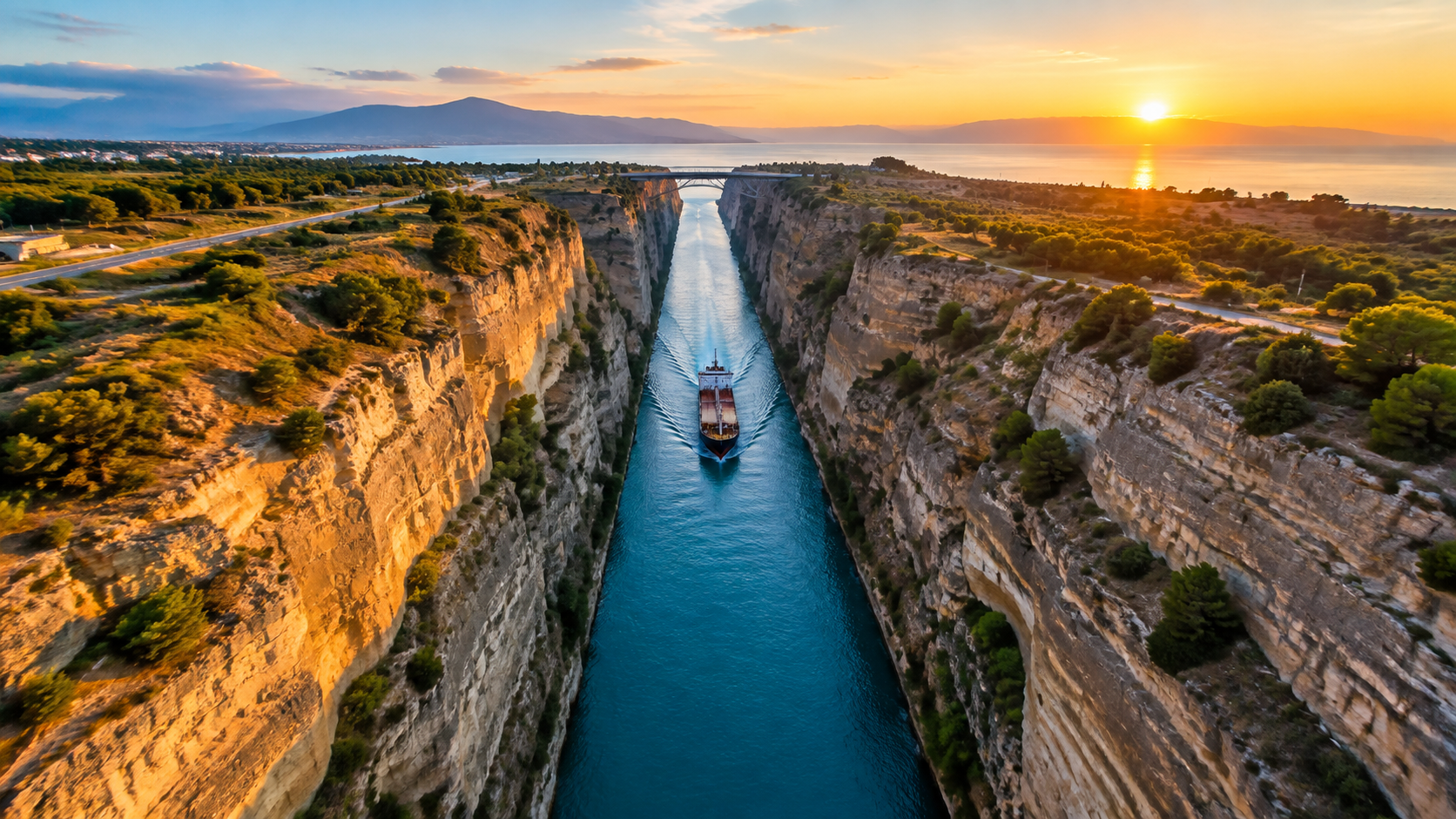
The Diolkos, a paved trackway for hauling ships overland, served the Isthmus of Corinth for nearly 1,400 years before emperors and engineers concluded that a canal was impossible. Nero began excavation in 67 CE with forced labor from 6,000 Jewish prisoners; his project collapsed within months. When French engineers resumed the effort in 1882, they faced the same geological gamble: four kilometers of Corinth limestone, unstable enough to slide but hard enough to blunt steam-powered excavators. The walls now rise 79 meters above sea level at their highest point, a sheer canyon that suggests scale more than any statistic. Why is the Corinth Canal important to maritime strategy? Before 1893, every vessel traveling between Brindisi and Piraeus rounded Cape Malea, adding fuel, time, and storm exposure. The canal collapsed that calculation into a six-kilometer passage, reordering trade flows across the eastern Mediterranean. Smaller freight operators and yacht charters gained the most; the canal's 21.4-meter beam excluded the container ships and bulk carriers that would dominate 20th-century commerce. What began as a universal shortcut became a niche route, its strategic value narrowing even as its symbolic weight grew. The Isthmus itself shaped Greek history long before the canal existed. Controlling the crossing meant controlling north-south land trade and forcing a choice on every east-west ship captain. Ancient Corinth extracted wealth from that bottleneck for six centuries. The canal's completion in 1893 ended the Isthmus as a barrier but entrenched it as a monument. Engineers who visit measure the precision of the vertical cuts; historians note that a French-led corporation finished what Greek antiquity conceived. For modern Greece, the canal stands as a threshold between the classical past and industrial sovereignty. Viewing the canal from the pedestrian bridge at Isthmia offers the clearest perspective on its engineering geometry and the depth that made construction so costly. The canal remains operational for vessels under 17.6 meters in beam, with transits coordinated by the Corinth Canal Authority. Free access to the bridge and surrounding overlooks means the site functions as both working infrastructure and public monument, a status few canals achieve.
“The canal collapsed that calculation into a six-kilometer passage, reordering trade flows across the eastern Mediterranean.”
The dream of severing the Isthmus of Corinth predates the classical age. Periander, tyrant of Corinth, conceived the project in the seventh century BCE but abandoned it after oracles warned of divine retribution. Instead, he commissioned the diolkos, a paved trackway that dragged ships overland—a pragmatic compromise that endured for thirteen centuries. Roman emperors revisited the canal scheme repeatedly. Nero launched excavations in 67 CE, deploying six thousand Jewish prisoners to dig the first cuts, but his assassination halted progress after only three months. The unfinished trenches remained visible for centuries, testament to imperial ambition outpacing engineering capacity. Construction resumed in 1882 under French and Greek engineers, financed by a Hungarian-led consortium. Dynamite replaced Roman pickaxes. Workers carved through Neogene marl and limestone, stabilizing vertical walls that rose to eighty meters. The canal opened to traffic on 28 October 1893, reducing the sea route between the Adriatic and Piraeus by 325 nautical miles. Why is the corinth canal important became clear within months: commercial steamers bypassed the treacherous Peloponnese circuit entirely, compressing transit times by days. The waterway handled over eleven thousand transits in its first decade, reshaping Mediterranean logistics. World War II brought strategic consequence. German forces fortified the canal, recognizing its military chokepoint value. British commandos demolished both ends in 1944 to block German retreat, collapsing the western bridge and filling the channel with rubble. Reconstruction took four years. Today, visitors standing on the submersible bridge at Isthmia look directly down the six-kilometer corridor, its limestone walls scored with the blast marks of nineteenth-century powder charges—engineering scars that explain why the canal remains a monument to persistence as much as to commerce.
Periander of Corinth plans a canal but abandons the project, constructing the diolkos trackway instead.
Emperor Nero begins excavation using six thousand laborers, digging initial trenches before his assassination ends the effort.
French engineer Béla Gerster resumes construction with dynamite and modern excavation techniques, backed by international investors.
The Corinth Canal opens on 28 October, cutting 325 nautical miles from the Adriatic-Aegean route and transforming Mediterranean shipping.
British commandos destroy both canal ends to impede German retreat, collapsing structures and filling the channel with debris.
Post-war reconstruction reopens the canal to commercial and recreational traffic after four years of clearance work.
The Corinth Canal serves as a crucial maritime shortcut that connects the Ionian and Aegean Seas by carving a direct path through the narrow Isthmus of Corinth. This engineering feat eliminates the need for smaller vessels to navigate the lengthy and often hazardous detour around the Peloponnese peninsula.
24.6-metre surface width
8-metre channel depth
79-metre rock walls
Significant distance reduction
No locks required
The best arrival window is 09:00–18:00, providing optimal daylight to observe the canal's 80-meter depth and watch transiting vessels. Planning your visit within these hours ensures clear visibility of the steep limestone walls and active maritime traffic.
Mild 18°C to 24°C
Pleasant temperatures and manageable visitor numbers facilitate easier viewing from the bridge.
Hot 28°C to 35°C
Peak tourism results in higher traffic; arrive early to secure a clear viewing position.
Mild 20°C to 26°C
Clear skies and comfortable warmth offer ideal conditions for observation.
Cool 10°C to 16°C
Minimal crowds provide a quiet experience, though shorter daylight hours limit the observation window.
Verdict: The optimal time to visit is during the spring or autumn shoulder months, arriving consistently between 09:00 and 18:00 to maximize daylight for viewing.
The Corinth Canal viewing areas are accessible throughout the week, offering consistent opportunities for visitors to observe the site.
Everything you need to know about why is the corinth canal important
The canal serves as a vital shortcut for small vessels navigating between the Aegean and Ionian Seas. By avoiding the long journey around the Peloponnese peninsula, ships save significant time and fuel.
As a feat of 19th-century engineering, this artificial waterway cuts through the Isthmus of Corinth to connect two gulfs. It remains a historic Greek landmark that physically separates the mainland from the Peloponnese.
The steep limestone walls rising up to 90 meters demonstrate the immense scale of this construction project. These vertical rock faces are key to understanding why is the corinth canal important as a human-made geological intervention.
Viewing the canal from the bridge is completely free of charge. You can walk along the pedestrian path to observe the narrow passage and the depth of the cut.
The optimal window for visiting is between 09:00 and 18:00 during daylight hours. This allows for the clearest view of the channel depth and the best opportunities to watch transiting vessels.
Families are welcome to visit the bridge area to observe the waterway together. It offers an educational environment to discuss civil engineering and local history in a safe, open-air setting.