
English| EUR
Suggested for you
More currencies
Choose a language
The Corinth Canal imposes one of the strictest size thresholds in European cruising. Only small expedition ships, luxury yachts, and select boutique vessels can navigate the 21.4-metre-wide channel that slices through the Isthmus of Corinth. This guide identifies which operators transit the canal, the specifications that determine passage eligibility, and how to experience one of the most engineered shortcuts in maritime history.
Quick answer
Small cruise ships with a beam under 17.6 metres can transit the Corinth Canal, including vessels operated by Windstar Cruises, Sea Cloud Cruises, Variety Cruises, and Ponant. Mainstream cruise lines with ships exceeding 20 metres in width cannot fit through the 21.4-metre-wide channel. Most transits occur between April and October when Mediterranean itineraries peak, with vessels booking passage slots weeks in advance through the canal authority.
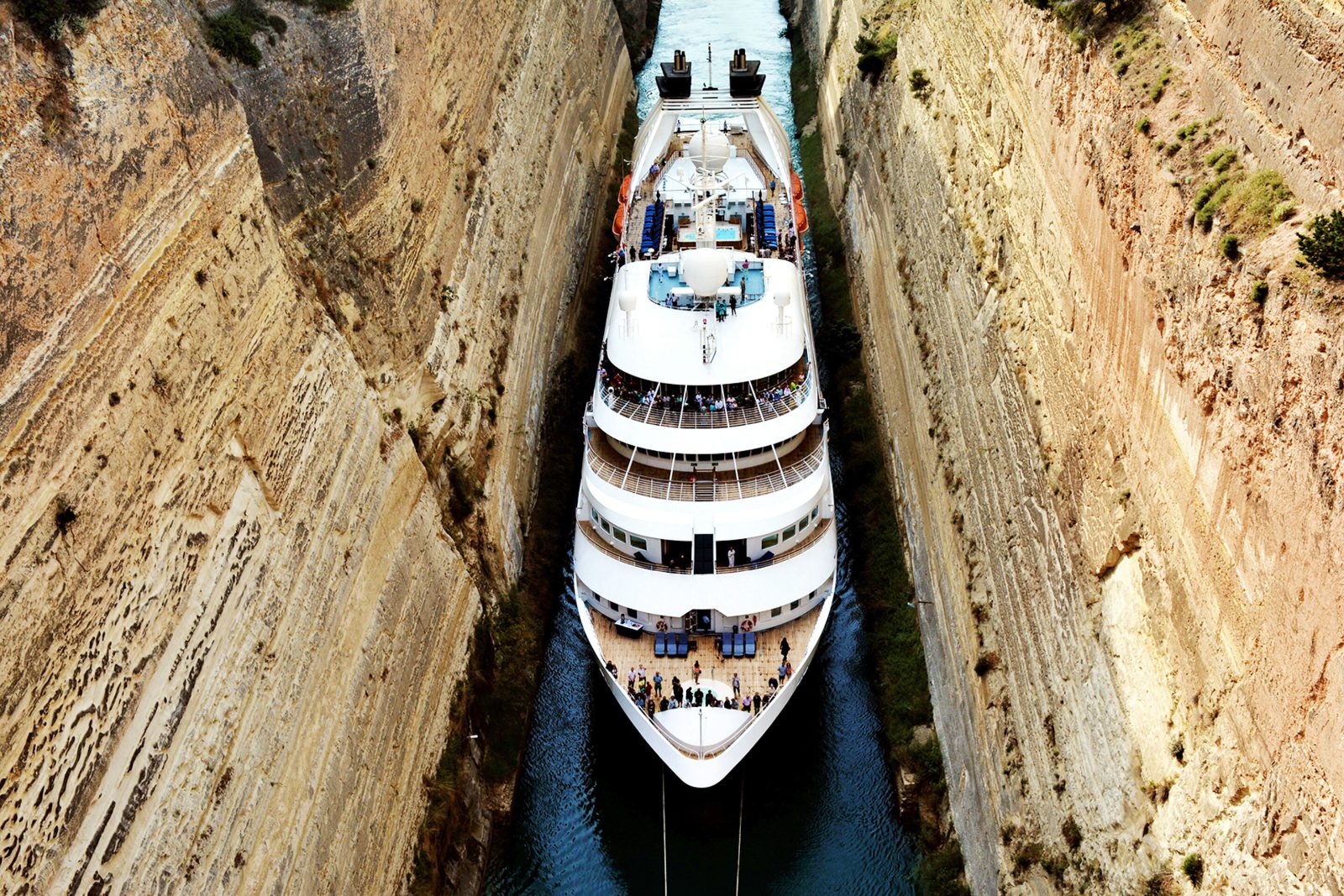
The Corinth Canal was never designed for modern cruise ships. Completed in 1893, the 6.4-kilometre-long waterway was carved to accommodate cargo steamers and naval vessels of the late nineteenth century, when a beam of fifteen metres was considered generous. Today, which cruise ships go through the corinth canal is determined entirely by whether their width can clear a 21.4-metre gap with enough margin for safe passage—a threshold that excludes ninety-five percent of the global cruise fleet. Windstar Cruises operates the Star Breeze, Star Legend, and Star Pride through the canal regularly, each with a beam of 19.5 metres. Sea Cloud and Sea Cloud II, both under eighteen metres wide, transit the channel on select Aegean voyages. Ponant's Le Champlain, Le Bougainville, and Le Dumont-d'Urville—expedition-class vessels with ice-strengthened hulls—also fit the profile. Variety Cruises, a Greek operator, runs the Galileo and Harmony V, both small enough to navigate the canal multiple times per season. These ships share a common design philosophy: narrow beam, shallow draft, and the ability to reach ports that mega-ships cannot. The limestone walls of the canal rise eighty metres on either side, close enough that passengers on deck can see the vertical striations left by dynamite and pickaxe. Transit takes roughly forty-five minutes at a controlled speed of four knots, with vessels often passing within two metres of the rock face. The canal operates around the clock most days, but Tuesday maintenance windows between 18:00 and 06:00 can close the passage entirely. Captains coordinate with the Isthmia control station to secure a transit slot, and delays due to larger commercial traffic or engineering work are not uncommon. Cruise lines planning corinth canal transits schedule voyages months in advance, building the passage into multi-day Aegean itineraries that link Athens, Nafplio, and the Peloponnese. The experience is less about the destination—there is no port stop at the canal itself—and more about the engineering spectacle of threading a floating hotel through a gap narrower than most city streets. For travelers comparing cruise options in Greece, vessel beam is the single specification that determines whether the Corinth Canal appears on the itinerary.
“The canal operates around the clock most days, but Tuesday maintenance windows between 18:00 and 06:00 can close the passage entirely.”
The Corinth Canal presents strict physical constraints that differentiate large-scale commercial cruise ships from specialized smaller vessels. Navigation is determined by the vessel's beam and draft, which limits transit options to ships designed for narrow passage.
| Standard Cruise Ships Large commercial vessels | Small Expedition Vessels Specialized canal-transit craft Recommended | |
|---|---|---|
| Vessel Size | Length exceeds 200 m, Beam exceeds 22 m | Length under 120 m, Beam under 17 m |
| Transit Capability | Requires open sea routes | Designed for 21.3 m wide canal passage |
| Operating Operators | Global major cruise lines | Boutique expedition and luxury lines |
| Passenger Capacity | Typically 1,500 to 5,000 guests | Typically 50 to 200 guests |
Verdict: Choose a small-scale expedition cruise if the Corinth Canal transit is a priority, as standard cruise ships are physically unable to navigate the canal's restricted dimensions.
The Corinth Canal presents significant navigational challenges due to its narrow width and high vertical walls, requiring specialized vessels for transit. Only small-ship cruise lines operating compact, maneuverable yachts are typically capable of navigating this passage safely.
The canal features a base width of only 21.3 meters, severely limiting the beam size of any vessel attempting transit.
The canal has a water depth of approximately 8 meters, necessitating careful draft calculations for all passing ships.
The canal walls rise up to 79 meters above sea level, creating a confined corridor that restricts the height and maneuverability of larger cruise ships.
Spanning 6.4 kilometers, the transit requires precise steering throughout the entire journey to avoid contact with the rock walls.
Most mainstream cruise liners are too wide to pass, leaving the route primarily to small-ship cruise lines and private yachts.
Due to the narrow margins, the canal authorities often require or recommend tugboat assistance for larger permitted vessels to ensure safe passage.
The strict width limitations mean that cruise ships must meet exact technical specifications to be granted transit clearance by the canal authority.
The best arrival window is 06:00–23:59, as this avoids Tuesday maintenance hours and benefits from 24/7 navigation availability. Planning around these operational hours ensures the most reliable transit experience.
Mild, 15°C–22°C
Ideal visibility for canal transit and photography.
Hot, 28°C–35°C
Busy periods often require advanced scheduling.
Cooler, 18°C–25°C
Stable conditions support consistent navigation windows.
Variable, 10°C–16°C
Fewer vessels, though maintenance schedules may vary.
Verdict: The optimal time to plan your transit is Wednesday through Monday, avoiding Tuesday maintenance closures, ideally during the mild climate of April or October.
Pedestrian access to the Corinth Canal is free of charge. Vessel transit requires the payment of maritime fees based on specific technical vessel parameters.
Verdict: Individuals pay 0 EUR to view the canal as pedestrians, while cruise ship transit costs are determined exclusively by maritime vessel specifications.
Everything you need to know about which cruise ships go through the corinth canal
Only smaller cruise ships that meet specific width and draft requirements can navigate the passage. Due to the narrow nature of this engineering landmark, large modern liners cannot fit through the channel.
Yes, the canal has strict maximum dimensions regarding beam and draft for all vessels. Operators must ensure their vessel specifications align with the current navigation safety protocols before attempting the transit.
Smaller private boats and yachts frequently navigate the waterway alongside excursion vessels. If you are researching which cruise ships go through the corinth canal for sightseeing, private boat tours are a popular alternative.
The best arrival window is between 06:00 and 23:59 to avoid scheduled maintenance on Tuesdays. Observing the passage during these hours provides the highest probability of seeing maritime traffic in the canal.
Transit fees apply to all vessels based on specific tonnage and category rather than a flat entrance fee. While pedestrian entry at the site is 0 EUR, private and commercial operators must coordinate directly with the canal authority for passage costs.
The canal operates 24/7 with the exception of Tuesday maintenance hours. This schedule allows for consistent maritime movement for those interested in seeing which cruise ships go through the corinth canal during their visit.